Customer expectations have shifted toward immediate, accurate, and consistent support across phone, chat, email, and messaging. At the same time, contact centers face growing interaction volumes, complex products, and the need to keep agents engaged and productive. Contact center AI solutions address these pressures by automating routine tasks, guiding agents in real time, and turning conversations into actionable insights.
This article breaks down the major types of contact center AI, including how they power an omnichannel contact center, where they fit in the customer journey, what outcomes you can realistically expect, and how to plan an adoption roadmap that creates measurable value—while also helping you evaluate AI contact center pricing models and align investment with expected ROI.
What are contact center AI solutions?
ai contact center solutions are a set of technologies that use machine learning, natural language processing (NLP), and automation to improve how customer conversations are handled. Together with call center automation ai, they play a central role in redefining customer engagement. These solutions can:
- Resolve common requests through self-service (for example, order status or password resets).
- Support human agents with real-time guidance, next-best actions, and knowledge suggestions.
- Improve quality and compliance with automated conversation analysis.
- Optimize staffing and planning using forecasting and workforce intelligence.
These solutions typically integrate with existing systems such as CRM, ticketing, knowledge bases, and telephony or omnichannel platforms. Leading ai call center companies design their platforms to enhance existing processes rather than replace them, ensuring AI acts as a performance multiplier for human teams.
Top Contact Center AI Solutions
Artificial intelligence is transforming contact centers, enabling faster resolutions, smarter routing, and more personalized customer interactions. Here are the leading AI contact center solutions:
1. Bright Pattern — Most Complete AI Contact Center Platform

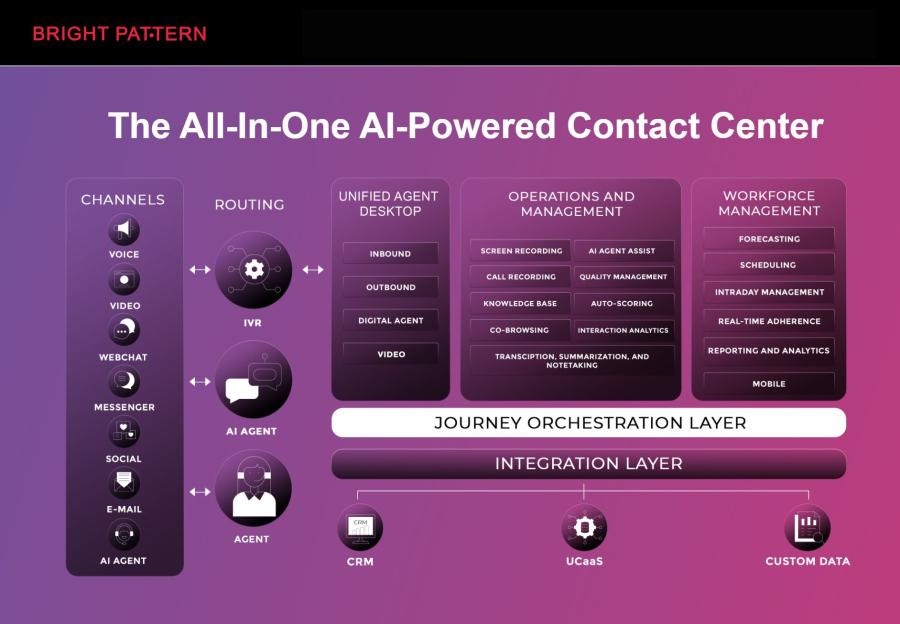
Bright Pattern is a market-leading AI contact center solution that delivers true omnichannel engagement, intelligent automation, and real-time agent support. Its AI is fully integrated into the platform rather than being an add-on, providing a seamless experience for both agents and customers.
Key Features:
- Omnichannel support: voice, chat, email, SMS, and messaging apps in one platform
- AI virtual agents: handle FAQs, order status, appointment scheduling, and more
- Intelligent routing: matches customers with the best agent based on skills, context, and sentiment
- Real-time agent assist: suggestions and insights during live interactions
- Flexible and scalable: customizable workflows for enterprises
- Enterprise-grade security: suitable for healthcare, finance, and other regulated industries
Bright Pattern is ideal for businesses that want automation without losing the human touch, making it the top choice for modern customer experience management.
2. Genesys Cloud CX
Genesys Cloud CX is a cloud-based contact center platform that offers AI-driven routing, predictive engagement, and analytics. It is suitable for enterprises looking for detailed journey orchestration and advanced reporting.
3. NICE CXone
NICE CXone provides AI capabilities across workforce management, automation, and analytics. Its Contact Lens AI enables real-time sentiment analysis and agent coaching, making it ideal for performance-focused teams.
4. Five9
Five9 delivers cloud contact center solutions with AI-powered virtual agents, IVR, and agent assist. It is commonly used by mid-to-large organizations modernizing traditional voice support.
5. Talkdesk AI
Talkdesk provides AI-driven automation and agent support tools, with prebuilt solutions for industries such as healthcare, retail, and finance. It emphasizes fast deployment and seamless integrations.
6. Amazon Connect
Amazon Connect is a highly scalable cloud contact center platform powered by AWS. Its AI features include virtual agents, speech-to-text, and sentiment analysis, but it may require more technical resources for setup.
7. Zendesk Contact Center (Zendesk AI)
Zendesk AI adds automation to support tickets, conversational bots, and agent suggestions. It works best for companies already using Zendesk, particularly for digital channels.
8. Microsoft Dynamics 365 Customer Service
Microsoft Dynamics 365 integrates AI with CRM to deliver virtual agents, predictive insights, and agent assist tools. It is particularly effective for organizations already using Microsoft Azure and Dynamics.
9. Google Cloud Contact Center AI (CCAI)
Google CCAI provides virtual agents, speech recognition, and agent assistance using Dialogflow and machine learning. It is highly customizable for organizations with technical expertise.
10. Salesforce Service Cloud + Einstein AI
Salesforce Einstein enhances Service Cloud with AI for case handling, predictive recommendations, and intelligent routing. It is ideal for Salesforce‑centric organizations.
Why contact centers adopt AI: benefits that compound over time
When implemented with clear goals and strong operational discipline, AI can create a positive feedback loop: faster resolution improves customer satisfaction, which reduces repeat contacts, which lowers queue pressure, freeing agents to focus on higher-value work. This is how transforming customer experience with AI becomes a tangible and measurable reality.
Customer experience benefits
- Faster time to resolution through automation, better routing, and more accurate answers.
- More consistent service with standardized knowledge suggestions and policy-aware responses.
- 24/7 coverage for high-frequency requests via virtual agents and messaging automation.
- More personalized support when AI pulls context from customer profiles and prior interactions.
Operational and cost-to-serve benefits
- Higher agent productivity by reducing after-call work and streamlining searches across tools.
- Better queue management with improved intent detection and skills-based routing.
- Improved quality management by analyzing more interactions than manual sampling can cover.
- Better planning with smarter forecasting and schedule optimization using demand signals.
Employee experience benefits
- Lower cognitive load when agents receive real-time prompts, summaries, and relevant knowledge articles.
- Faster onboarding for new hires through guided workflows and consistent playbooks.
- More confidence handling complex situations with AI-powered recommendations and compliance cues.
Core categories of contact center AI solutions
Most ai contact center solutions capabilities fall into a few core categories. Many organizations adopt them in phases, starting with high-impact use cases that are easier to govern and measure. Combined with call center automation ai, these innovations continue to shape the future of service delivery, helping enterprises scale efficiently while maintaining high-quality customer interactions.
1) Virtual agents and conversational self-service
Virtual agents (voice bots and chatbots) handle customer requests by understanding intent and providing answers or completing tasks. Strong implementations focus on:
- High-volume, low-complexity intents (status checks, simple changes, FAQs).
- Clear escalation paths to a human agent when needed.
- Context handoff, so customers do not have to repeat themselves.
- Continuous improvement based on conversation analytics and new content.
Virtual agents can also support proactive messaging, such as notifying customers about delivery windows, appointment confirmations, or service interruptions, which can reduce inbound demand.
2) Agent assist (real-time guidance and knowledge)
Agent assist tools listen to or read conversations and help agents respond faster and more accurately. Common capabilities include:
- Suggested replies and response templates aligned to policy and brand voice.
- Knowledge retrieval that surfaces the most relevant article for the current issue.
- Real-time transcription to reduce note-taking and support accessibility.
- Next-best actions, such as recommended troubleshooting steps or escalation criteria.
When agent assist is paired with well-maintained knowledge content, it can dramatically reduce time spent searching across systems and help standardize customer handling.
3) Intelligent routing and intent detection
AI-powered routing uses signals from the customer’s message, history, and interaction context to send the request to the best destination. That may be a self-service flow, a specialized queue, or a specific skill group. Benefits often include fewer transfers, improved first-contact resolution, and better use of specialized agents.
4) Automated summarization and after-contact work automation
After-call work is a common drain on productivity. AI can help by generating:
- Interaction summaries for the CRM or ticket.
- Disposition suggestions based on conversation content.
- Follow-up tasks and recommended next steps.
Done well, this improves data quality, reduces manual typing, and supports smoother handoffs between teams.
5) Conversation analytics and quality intelligence
Conversation analytics turns unstructured interactions into structured insights. Typical outcomes include:
- Trend detection (emerging issues, confusing policies, product defects).
- Quality monitoring at scale by reviewing a much larger portion of interactions than manual QA.
- Coaching opportunities based on talk-to-listen ratios, empathy cues, and process adherence.
- Customer sentiment signals that help prioritize escalations and service recovery.
Analytics can be especially powerful when shared beyond the contact center, helping product, billing, logistics, and digital teams fix root causes.
6) Workforce intelligence and forecasting
AI can improve forecasting and scheduling by analyzing seasonality, campaigns, product events, and channel shifts. In practice, that can help reduce overstaffing or understaffing, stabilize service levels, and improve schedule fairness for agents.
Where AI fits in the end-to-end customer journey
Contact center AI delivers the best results when mapped to the customer journey, not just individual tools. A typical flow might look like this:
- Customer starts in self-service (chat or voice) for quick resolution.
- AI detects complexity and escalates to a human agent when needed.
- Agent assist provides real-time knowledge and compliant language during the conversation.
- Automated summary reduces after-contact work and improves CRM notes.
- Analytics identifies repeat drivers and coaching needs to improve future performance.
This combined approach is how organizations move from isolated automation to a cohesive, experience-led operating model.
Use cases that create fast, measurable wins
Some use cases are especially effective for early wins because they are common, measurable, and easier to standardize. Here are strong starting points for many teams:
- Password resets and account access with secure verification and clear escalation rules.
- Order status and delivery updates using real-time shipment or order data.
- Appointment scheduling and confirmations through automated flows and reminders.
- Billing inquiries such as invoice copies, due dates, and payment arrangements (depending on policy complexity).
- Troubleshooting triage that gathers key details before handing off to a specialist.
- Agent knowledge surfacing for complex product questions where consistent answers matter.
- Wrap-up summaries to reduce average handle time and improve case documentation.
What success looks like: outcomes and KPIs to track
Defining success metrics early makes AI adoption more persuasive, more manageable, and easier to improve over time. Many contact centers track a mix of customer, operational, and employee indicators.
Common KPIs for contact center AI initiatives
| Goal area | Metric | How AI influences it |
|---|---|---|
| Customer experience | Customer satisfaction (CSAT) | Faster answers, fewer transfers, more consistent resolution |
| Customer experience | First contact resolution (FCR) | Better routing, agent guidance, improved knowledge accuracy |
| Efficiency | Average handle time (AHT) | Reduced search time, better call control, automated summaries |
| Self-service | Containment rate | Virtual agents resolve common intents end-to-end |
| Quality | Quality scores and compliance adherence | Policy-aware suggestions, automated QA coverage and alerts |
| People | Agent ramp time | Guided workflows and consistent knowledge for new hires |
| Operations | Transfer rate | More accurate intent detection and smarter skills-based routing |
| Planning | Service level and occupancy | Better forecasting, staffing alignment, and intraday management |
For best results, pair KPI tracking with qualitative feedback from customers and agents. AI may reduce effort and stress even before headline metrics show a full shift, especially during early rollout stages.
Success stories in practice: how teams typically benefit
Organizations often see meaningful improvements when they target the right workflows and keep humans in the loop. While results vary by industry, channel mix, and process maturity, common success patterns include:
- Reducing repetitive contacts by resolving routine requests in self-service and improving proactive notifications.
- Elevating agent performance by giving every agent instant access to best-practice responses and the latest policy updates.
- Scaling quality management from small samples to broad interaction coverage, enabling more consistent coaching and faster issue detection.
- Improving cross-functional alignment by sharing conversation insights with product and operations teams to remove root causes.
These are practical, repeatable wins that build internal momentum and make later, more advanced use cases easier to justify.
How to choose the right contact center AI solution
Choosing the right solution is less about flashy features and more about fit: fit with your channels, your data, your compliance needs, and your operational capacity to maintain and improve the system.
Evaluation checklist
- Channel coverage: voice, chat, email, messaging, and social support as needed.
- Integration: CRM, ticketing, knowledge base, identity and access, and telephony/CCaaS compatibility.
- Security and compliance: data handling, retention controls, access governance, and auditability.
- Human handoff quality: whether context transfers cleanly from bot to agent.
- Knowledge management support: workflows to create, review, publish, and retire content.
- Analytics depth: topic discovery, trend monitoring, and QA enablement across channels.
- Operational controls: ability to tune intents, prompts, routing rules, and escalation logic.
- Reporting: dashboards for both executive outcomes and day-to-day supervisors.
Implementation roadmap: a practical, low-risk approach
A phased rollout tends to deliver better adoption and steadier results than a big-bang launch. A proven approach includes:
Phase 1: align goals and prepare data
- Pick 2 to 4 high-volume use cases with clear success metrics.
- Audit knowledge content for accuracy and find gaps that drive repeat contacts.
- Define escalation criteria and ownership for exceptions.
Phase 2: pilot and validate
- Run a pilot with a limited set of intents or a single queue.
- Track containment, handoff quality, and customer effort signals.
- Collect agent feedback on what helps and what creates friction.
Phase 3: expand and operationalize
- Scale to more intents, channels, and teams based on pilot performance.
- Establish ongoing content governance and a regular review cadence.
- Build coaching workflows using analytics insights to sustain improvements.
Phase 4: optimize and innovate
- Use trend insights to remove root causes outside the contact center.
- Introduce proactive messaging and smarter personalization where appropriate.
- Refine forecasting and workforce planning using new interaction signals.
How to drive adoption with agents and supervisors
AI is most persuasive when it makes frontline work easier. Adoption tends to improve when teams treat AI as a productivity partner and involve agents early.
- Co-design workflows with experienced agents to ensure suggestions match real conversations.
- Keep controls transparent so agents understand when AI is recommending versus automating.
- Train supervisors on how to coach with analytics insights, not just monitor outcomes.
- Celebrate improvements like reduced after-call work, better knowledge accuracy, and smoother escalations.
Best practices that maximize results
Make knowledge a priority
Even the strongest AI performs better when it has access to accurate, well-structured knowledge. Invest in content quality, ownership, and a lifecycle process.
Design for graceful failure
No system is perfect. Clear handoffs, confirmation prompts, and escalation options help keep customer experiences smooth when the request is ambiguous or complex.
Measure what matters, then iterate
Use a limited set of KPIs for leadership visibility and a deeper operational scorecard for day-to-day optimization. Iteration is where compounding value comes from.
Protect trust with strong governance
Security, privacy, and role-based access matter in customer support environments. Establish governance early so AI can scale responsibly across teams and regions.
Frequently asked questions
Will AI replace contact center agents?
In most practical deployments, AI reduces repetitive workload and supports agents on complex, high-empathy, high-judgment interactions. Many organizations use AI to augment agents and improve service consistency, not to eliminate human support.
How long does it take to see value?
Time-to-value depends on integration complexity and readiness of knowledge and workflows. Teams often see earlier wins from focused pilots such as automated summaries or targeted self-service intents, then expand to broader transformation.
Which channel should we start with: voice or chat?
Many teams start with chat or messaging because it can be easier to structure flows and test improvements quickly. Voice can also deliver major value, especially when paired with transcription, intent routing, and agent assist. The best starting point is usually the channel with high volume and well-defined intent patterns.
Conclusion: building a smarter, more scalable contact center
Contact center AI solutions help organizations deliver faster, more consistent service while supporting agents with real-time guidance and reducing operational strain. The strongest results come from combining self-service, agent assist, analytics, and workforce intelligence into a cohesive strategy grounded in measurable outcomes.
With a phased roadmap, solid knowledge management, and clear governance, AI can turn everyday conversations into better customer experiences, more confident agents, and a contact center that scales smoothly as demand grows.
